 Courtesy of Dr. L. Mike NayakSave this storySave this story
In the race for best facelift, the sleekest neck wins, especially on the internet. Because while a keen eye can appreciate the finer points of a facelift—a subtly lifted cheek or the softening of shadows around the mouth—what tends to elicit the most viral Wow is the jawline in profile: that transcendent shift from saggy to sharp, obtuse to acute. The unveiling of definition that has long been obscured. This has always been true to an extent, but in 2026, optimizing those angles has become something of an extreme sport. We’re not talking about bonesmashing (thank god), but rather submandibular gland reduction—a trimming of the salivary glands that sit under the jawbone. The term is slightly less obvious in its intent, but it’s a plastic surgery technique which is, historically speaking, only slightly less controversial than hammering one’s face in the name of looksmaxxing.
While the procedure was first described in the aesthetic literature in 1987, it was hardly the standard of care back then. “In the past, the perception amongst plastic surgeons was that submandibular gland reduction was a risky operation with a high complication rate,” says T. Gerald O’Daniel, MD, a triple board-certified plastic surgeon and facial plastic surgeon in Louisville, Kentucky. (Such presumptions weren’t based on published data, but there are risks involved, which I’ll get to in a bit.) Even 25 years ago, when Dr. O’Daniel first started reducing glands, only a handful of plastic surgeons were performing the maneuver—and often they were vilified for it. “There were doctors who would stand up at big medical meetings and say that what we were doing was malpractice,” he recalls.
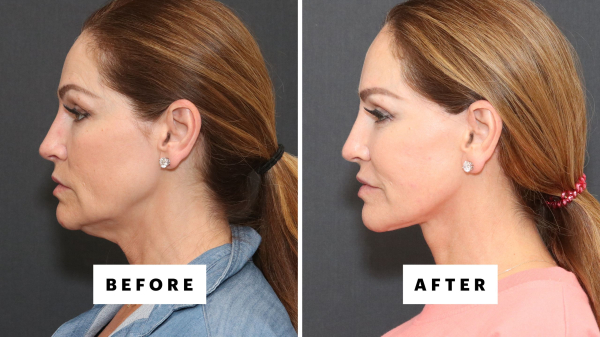
A patient of Dr. O’Daniel before (left) and 8 months after (right) a deep-plane neck and facelift with submandibular gland reduction (plus upper and lower blepharoplasty and fat transfer). Images courtesy of Dr. Gerald O’Daniel.
This happened as recently as 2018, says Dr. O’Daniel. The most passionately opposed argued that cosmetic gland reduction was radical and dangerous, because it involves operating on highly vascular (filled with blood vessels) structures, in a confined space underneath the platysma muscle of the neck. An uncontrolled bleed in this area can obstruct the airway, potentially leading to death.
So why consider it? In certain people, the submandibular glands—as well as the adjacent fat pockets and digastric muscles (which aid in swallowing, chewing, and speech)—can give a look of fullness, blunting the border between the face and neck. (Some are born with large glands; in others, the glands protrude with age.) In such cases, “there’s a limit to how sharp of a jawline I can give them” without treating the impeding glands, explains New York City board-certified plastic surgeon Ira Savetsky, MD. In his experience, when the glands are small and in a more favorable position (tucked up, out of sight, in the floor of the mouth), he can often “resuspend them indirectly” by tightening the platysma over them “to sort of bolster them up.”
While Dr. Savetsky trims patients’ glands selectively, in only about 10 percent of his first-time facelifts and 15 to 20 percent of secondary cases, other surgeons do it routinely, 70, 95, or even 100 percent of the time, believing their patients’ happiness with their results depends on it. (And Dr. Savetsky does say: “I believe the number of patients who could aesthetically benefit from addressing it is higher. However, when I have a thorough discussion—including the inherent risks of the procedure—many patients ultimately choose to decline and accept the limitations of their neck contour.") Then there are those who, as a rule, never touch the glands, insisting that the risks outweigh the benefits. “I’m not saying it’s absolutely the wrong thing to do—it can be done safely, many times in a row, by talented surgeons—but, for me, it’s the wrong thing to do given my risk comfort,” says David Rosenberg, MD, a double board-certified facial plastic surgeon in New York City. His stance isn’t a formal denunciation, however. “This is a personal decision based on the fact that I’ve built a thriving practice, with wonderful outcomes, without taking that added risk.” While he acknowledges that catastrophic bleeds related to the glands are very rare, he adds, “I don’t want to go to sleep at night wondering if something terrible is going to happen.”
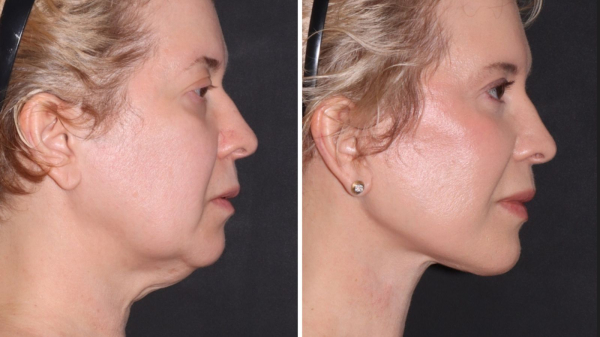
The same patient of Dr. O’Daniel before (left) and 8 months after (right) a deep-plane neck and facelift with submandibular gland reduction (plus upper and lower blepharoplasty and fat transfer). Images courtesy of Dr. Gerald O’Daniel.
The fear has been hard to shake. In 2021, when The Aesthetic Society surveyed its members about certain “novel or less mainstream” procedures, 89% said they don’t perform submandibular gland reduction, with most citing “danger to the patient” as the main reason. The majority also reported that they had not learned the procedure in training. Ultimately, the society concluded that “when comparing the perceived complication rates with data published in the literature, particularly when looking at rates of serious or life-threatening complications, plastic surgeons overestimate the risk of procedures with which they are less familiar.”
In 2026, however, gland reduction is gaining ground. For the better part of two decades, Dr. O’Daniel has taught facelift cadaver courses—dissection-focused anatomy labs for surgeons aiming to hone their skills or acquire new ones. For the longest time, he says, very few attendees knew how to treat the glands or expressed any interest in learning. But this past year, when Dr. O’Daniel asked a group of surgeons how many routinely reduce the glands, two-thirds raised their hands—and the rest were eager to learn how to do it safely.
The uptick is being driven by patients who are requesting the procedure. “They often come in knowing more facelift terminology than some plastic surgery residents,” Dr. Savetsky says (not entirely in jest). And they’re “pushing for better and better results,” adds Garrett Locketz, MD, a double board-certified facial plastic surgeon in Denver. The savviest among them have come to realize that “in some people, the submandibular gland is the thing that stands between a good neck and an outstanding neck.”
Why some plastic surgeons treat the glands and others do not
With esteemed experts sharing conflicting opinions on social, some patients are naturally confused about the merits of gland contouring. “There’s a group of surgeons who are doing this routinely, and they promote it in a way that makes you think if you’re not getting it, you’re going to have a lesser result,” Dr. Rosenberg says. Is there any truth to this?
L. Mike Nayak, MD, seems to think so. “It really just comes down to: How good of a result do you want and what are you willing to do to get it,” says the double board-certified facial plastic surgeon from St. Louis. Going under the platysma to debulk glands and other tissues, as one does in a deep neck lift, demands the utmost proficiency and adds time and risk to the operation, he says, but it typically garners a cleaner, crisper outcome than a traditional neck lift (which tightens muscle, redrapes skin, and perhaps removes some of the fat lining the skin).
“I truly believe there’s no reason for a debate if the question is, Which technique gives a sharper neckline?” adds board-certified San Francisco plastic surgeon Dino Elyassnia, MD, when asked about his peers’ polarizing viewpoints. “There’s a drastic difference in the shape of the neck when you treat the deep layer.”
To understand why, imagine your mandible, or lower jawbone, as a container of sorts. (Trust: Four different surgeons explained gland prominence using this analogy.) In someone with a deep, well-defined jawline, “the gland is completely hidden within the confines of the horseshoe of the mandible,” Dr. Nayak says. But if the gland expands or droops, which is common with age, a portion of it can escape those confines, bulging out below the jawbone and appearing as a lump in the neck. Even if your glands aren’t especially sizable or saggy, they can still show themselves due to bone loss. Inevitably, “the mandible shrinks over time, so the depth of our container is getting smaller,” adds Dr. Nayak. But age isn’t always the instigator: “Some people are born with a small container and/or too much volume, and their necks tend to go straight down,” notes Dr. O’Daniel. In a 2021 study, he found that the majority of volume in the neck is related to the submandibular glands, the digastric muscles, and the deep fat, which can only be accessed and addressed by going under the platysma.
According to Dr. Locketz, there are two types of patients who can usually benefit from gland contouring: Those with genetically rounded or heavy necks, who’ve always had “fullness in the deep neck structures,” and also, conversely, very thin patients, whose necks may display the submandibular glands more prominently. In Dr. Locketz’s practice, these two groups represent 50% of his patients.
Other surgeons say they encounter obvious glands less frequently. When Dr. Rosenberg recently reviewed his last 300 facelifts, “only three had evidently large submandibular glands,” he says. “So, yes, there is a very small percentage who would have a better neck if we [reduced] those glands, but it's just a little too scary for me to contemplate.” In such cases, he’s transparent with patients, explaining that while their neck will look more youthful after surgery, the glands will still be visible. “I put my hands on their face and neck and show them what the outcome will be, and I say, I am not the surgeon to take these [glands] out, if that is important to you.” To be clear, Dr. Rosenberg does perform a version of the deep neck lift (which he describes in this 2025 study). He tailors the deep fat and digastric muscles in 100% of cases, but always avoids the glands. In his experience, “a great facelift lifts the gland up if it’s small—I’m lifting the gland with the platysma muscle,” he says.
Amir Karam, MD, a double board-certified facial plastic surgeon in San Diego, takes a similar position. Beyond being risk-averse, he says, “I don’t feel the need to [reduce the glands], because the upward vector [direction] of my facelift supports the floor of the neck and brings the glands back up into their natural position.”

A patient of Dr. Karam before (left) and four months after (right) a facelift without submandibular gland reduction (plus a lower blepharoplasty, a lip lift, and fat transfer). Images courtesy of Dr. Amir Karam.
But some surgeons call this a fallacy. They say that attempting to hoist heavy glands, by using the platysma as a sort of hammock or sling, is essentially a fool’s errand. “The platysma is a very thin muscle—even in Arnold Schwarzenegger, it’s not going to be any more than two millimeters in thickness—and it has no structural integrity and zero lifting capacity,” says Dr. O’Daniel. “You can tighten it and make the neck look pretty for three or six months—you might even get a year out of it.” But eventually, the muscle relaxes and “you can start to see the glands protruding.”
Aiming to lift the glands out of sight—particularly into a too-small container—can sometimes backfire, casting them in high-def. “The glands sit in that space where we want to create separation between the face and the neck, and when we just lift the platysma over the glands, it’s almost like pulling a sheet tight over a pillow when making your bed,” explains Gabriele Miotto, MD, a board-certified plastic surgeon in Atlanta. “The pillow will still be there—and sometimes tightening the sheet over it makes it even more visible.”

A patient of Dr. Miotto before (left) and 6 months after (right) a deep-plane face and necklift with submandibular gland reduction (plus an upper and lower blepharoplasty, a temple brow lift, and fat transfer). Images courtesy of Dr. Gabriele Miotto.
While some facelift patients are focused on big-picture rejuvenation and don’t mind seeing a hint of glands, others are less tolerant. “There are patients who, if we don’t treat the glands, will not have an optimal result,” says Dr. Locketz. Or even an acceptable one: Years ago, before he started tackling glands, he says, “I had to tell a handful of patients, ‘Look, you have heavy glands and we're not going to reduce them. Everything else is going to look good, but you're still going to have fullness in this area.’ And they’d say, ‘No problem, that won't bother me.’ Well, guess what? It did bother them.”
Dissatisfied patients are what initially motivated Dr. O’Daniel, decades ago, to start treating glands routinely. They’d often return a year after surgery “complaining that they had these lumps in their necks and didn’t have a great angle.” Some time later, a colleague convinced him to rein in his gland reductions, arguing that the glands could instead be moved into a more favorable position by adjusting the platysma using a specific technique. “I pulled back to where I was doing glands only 60% of the time, but I didn’t like the results,” he says. And neither did his patients. He returned to trimming the glands in every first-time facelift. (Repeat lifts may not need it, if the glands were addressed in round one.) Interestingly, the surgeon who once tried to steer Dr. O’Daniel away from routine reductions now treats the glands himself in the majority of his own facelift patients, Dr. O’Daniel says.
Dr. Nayak has a similar story. In 2008, he tried to pull back a bit, sparing any glands he deemed borderline. “I partially bought into the ‘we can get equal results with less surgery’ rhetoric—and that was a terrible mistake,” he says. “Basically every time, the patient would come back and say, ‘I don’t like these lumps’ or ‘My jawline doesn’t look like [that of] your other patients.’ The vast majority of them went back to surgery.” He now trims the glands in 95% of his facelifts.
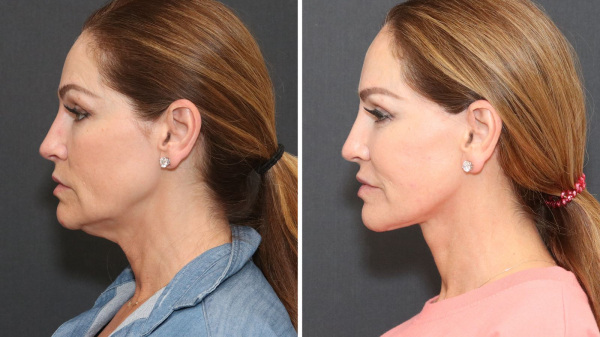
A patient of Dr. L. Mike Nayak, before (left) and one year after (right) a deep-plane neck and facelift with submandibular gland reduction (plus upper and lower blepharoplasty, brow lift, and fat transfer). Images courtesy of Dr. L. Mike Nayak.
Dr. Karam actually had the opposite experience: “Early on in my practice, I got into this whole deep neck concept [the included gland trimming] and, ultimately, some patients ended up getting weird-looking contour irregularities down the road,” he says. “From certain angles, you could see a little divot or void where the gland was removed. I felt like I was making things worse rather than better.” Over time, he says, “I’ve gotten much more conservative with what I do in the neck and I’ve never had a single patient complain, before or after surgery, about their glands.”
The risks of treating the submandibular glands
The most dreaded risk, without question, is profuse bleeding in the neck during or after surgery. While hematomas (accumulations of blood under the skin) are shown to occur in 1.15% of patients, there’s been only one reported case of a life-threatening bleed related to aesthetic submandibular gland reduction (the doctor acted fast and saved the patient). Still, several surgeons mentioned hearing of close calls. “It’s rare, but if it happens and your doctor isn’t close by, that’s scary shit,” says Dr. Rosenberg.
While Dr. O’Daniel says he’s never had a submandibular gland bleed after surgery, he has seen significant bleeding during surgery. “It is impressive when it bleeds and you have to know how to control it,” he says. Dr. Elyassnia adds that “there have been surgeons, historically, who’ve had really bad bleeds during surgery, and it scared them so much that they didn’t do the procedure again after that. It can be scary for the unprepared surgeon.”
Dr. Nayak makes the point that “bleeding is the number-one complication of a facelift, period,” with or without gland reduction. “The glands add a new and higher-risk place from which you could bleed, but it's not like if you don't do submandibular gland surgery [with a facelift], your chance of bleeding is vanishingly small. You can have a bleed in the neck that is life-threatening without having ever violated the deep neck—all neck surgery carries this risk,” he says. “If a surgeon isn’t capable of controlling bleeding, they shouldn’t be doing the surgery. And if they don’t have the medical judgment to assess a complication, or they aren’t equipped and available to handle an emergency in the middle of the night, they shouldn’t be doing the surgery.”
Another potential risk of gland reduction (and facelifts in general) is nerve injury. “There are nerves on the outside layer of the submandibular gland, and if they get injured by heat, stretch, pressure, or cutting, you can have temporary or permanent motion problems, like lower lip weakness,” explains Dr. Nayak. Studies rank this the most common complication of gland surgery, with one citing an incidence of 7.9%, another 9.8%, and a third 7.9%. This is typically a short-term problem, surgeons say, resolving within two weeks to six months.
After surgery, there’s a 1.33% chance of the treated glands leaking saliva. As a preventative measure, surgeons often inject the glands with Botox during the operation in order “to reduce their secretion of saliva” in the days following, says Dr. Miotto. They also restrict mouth-watering foods—anything dry, sour, spicy, or salty—as well as hard candies and chewing gum for a couple of weeks post-op. Some surgeons place a drain under the platysma to guard against salivary leaks. If one occurs, doctors will draw out the fluid with a needle and possibly apply a surgical net to keep it from pooling again.
Dry mouth is a concern, but surgeons say they rarely, if ever, have patients complain of this after gland reduction—and studies confirm the negligible risk. A 2025 review of complication rates in aesthetic submandibular gland reduction looked at 11 studies involving 3,379 patients and noted one case of chronic dry mouth. Salivary production is generally unaffected, surgeons say, because they are not removing the glands. “It’s a trim, usually of the superficial lobe of the gland that hangs down below the mandible,” Dr. Miotto reiterates. The remaining portion still functions—and you still have four other major salivary glands and thousands more minor salivary glands. That said, if a patient has a preexisting diagnosis of dry mouth or a condition that predisposes them to dry mouth, like Sjögren's syndrome, doctors might advise against gland reduction.
Some surgeons count “undercorrection” as a risk—not removing enough gland to get the desired angle—“but that’s more of a disappointment than a complication,” notes Dr. O’Daniel.
Dr. Karam warns of the opposite: an overdone or surgical-looking neck. He maintains that very few people, even in youth, have “an Egyptian-art, 90-degree kind of neck,” and that by attempting to deliver a sculpted effect in someone who’s never had it, “you run the risk of creating an outcome that doesn’t look completely natural.” He adds, “I’ve done secondary neck lifts on patients who’ve had deep neck work in the past, and, to me, they look overly carved out.”
The “cobra neck” and what causes it
In extreme cases, not treating the glands can carry its own peculiar risk: the so-called cobra neck deformity, which is “caused by thoroughly sculpting the middle third of the neck—scooping out fat from under the chin—without leveling off the two outboard fullnesses,” says Dr. Nayak, referring to the submandibular glands.
The fat and the glands “are sort of a package deal,” Dr. Elyassnia adds. “When you trim one thing, you’ve got to make sure the neighboring structures are also nicely contoured.” The way he sees it, “if you’re taking out an appropriate amount of deep fat—enough to create a sharp contour—then you almost always have to trim a piece of each salivary gland in order to get a really clean jawline.” Dr. Savetsky also considers deep neck sculpting an “all or nothing” proposition. In his experience, “if you’re taking out fat and digastric muscles from underneath the platysma, you kind of have to then take out [a portion of] the glands to avoid getting a cobra neck deformity.”Lef
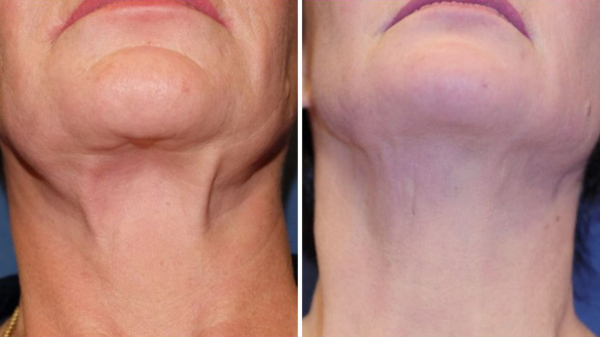
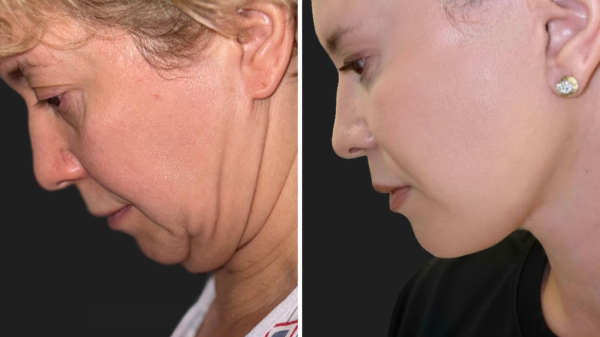
Left: A patient after a deep-plane neck and facelift that created a “cobra neck deformity.” Right: One year after Dr. O’Daniel performed a secondary neck and facelift that included submandibular gland reduction. Images courtesy of Dr. O’Daniel.
But, surprise, not everyone agrees. Dr. Rosenberg, who consistently tailors the deep fat and digastrics while sparing the glands, says, “My results are uniform and supported.” In his opinion, the importance of gland reduction is “radically overemphasized.” Dr. Karam tells me that he takes a modest amount of fat from some patients, but ignores the glands across the board and “can’t even remember the last time [he] touched the digastrics.” Such measures, he insists, are “not necessary to make patients feel good about their necks.”
Not for novices: surgeons speak out about safety
The swift rise of submandibular gland reduction has some surgeons concerned. “I didn’t do a submandibular gland reduction until I had done probably 200 facelifts,” says Dr. Locketz. “So, when I see fellows, who’ve only ever done five facelifts, attempting gland reduction, I worry for their patients.” Dr. Rosenberg agrees: “It's scary to think about young, inexperienced surgeons doing this,” he says. “They’re just starting out, they're nervous already, they're not used to treating problems—and this is the grandest of all problems if it bleeds.”
Dr. O’Daniel fears that submandibular gland surgery could “become the Brazilian butt lift [BBL] of the future, where complications are much more common.” He reminds me that the surgeons who first developed the BBL took a slow-and-steady approach, studying the procedure, practicing it, and performing it with caution. But as the BBL took off, and more surgeons began offering it—often without the necessary training—complications skyrocketed and the BBL earned a lethal reputation. Likewise, he says, the doctors who pioneered gland reduction decades ago were mostly meticulous and unhurried, but with the procedure now exploding, danger looms. “The risk absolutely outweighs the benefit if you’re not prepared,” he says.
When consulting with board-certified plastic surgeons and facial plastic surgeons, inquire about their training and how frequently they perform gland contouring. Ideally, they learned the basics in residency or fellowship and have subsequently evolved their skills by observing veteran surgeons operate, participating in cadaver labs, and attending lectures on the topic. Ask to see examples of their work—necks with glands treated as well as those with glands untouched. Surgeons can also simulate both scenarios on you by lifting with their fingers.
Be aware that deep neck work can add about an hour to a facelift, which means a longer stretch in the operating room, more time under anesthesia, and a higher price tag. It can also prolong your recovery: It may take up to three months for swelling to recede and tissues to soften (versus closer to one month with a basic neck lift). Expect your surgeon to review the risks of surgery as well as “the likelihood of the risks in their hands,” notes Dr. Locketz, “because the rates of complications in the literature are generally underreported.”
Whatever you decide, make sure your expectations align with your surgeon’s. “It’s totally fine to leave the submandibular gland, even when it's large,” says Dr. Miotto. “It may limit the degree of definition we can achieve, but we can still make beautiful results.”